The Environmental and Financial Benefits of E-Waste Recycling for Local Businesses
Last updated: May 20, 2026
Quick Answer: E-waste recycling saves local businesses money on disposal costs, protects them from data breach liability, and keeps toxic materials out of San Antonio landfills. For businesses generating end-of-life computers, monitors, and peripherals, formal recycling programs — especially free ones — turn a compliance headache into a competitive advantage and a genuine environmental win.
Key Takeaways
- 62 million tonnes of e-waste were generated globally in 2022, and only about 22% was properly recycled [5].
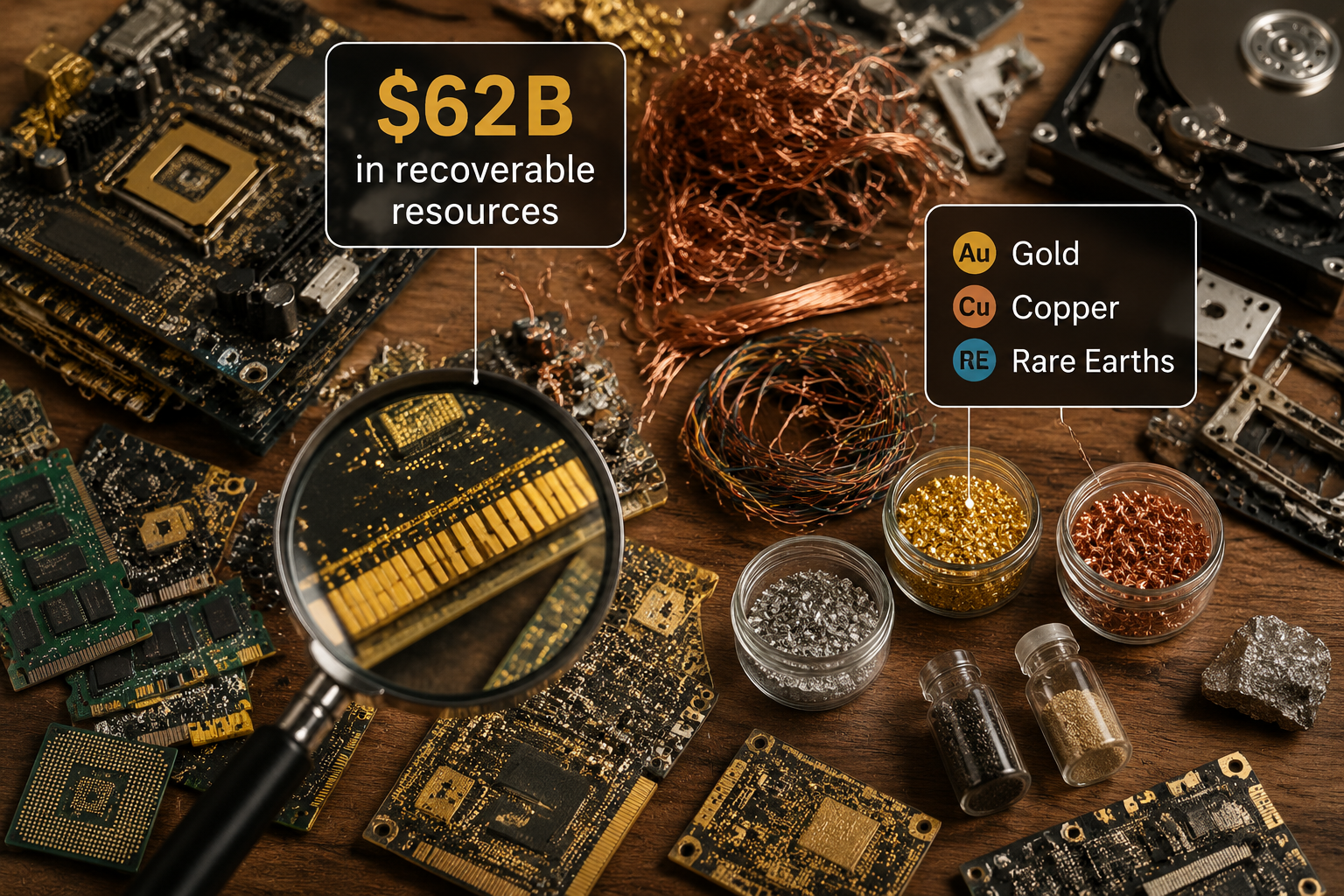
- An estimated $62 billion in recoverable metals (gold, copper, rare earths) goes unrecovered each year because devices aren’t formally recycled [2].
- Certified data destruction protects businesses from breach-related fines and lawsuits when retiring old IT equipment.
- E-waste recycling supports San Antonio’s local green initiatives and helps businesses attract eco-conscious clients.
- Free business recycling services exist — going green doesn’t have to cost a thing.
- Professionally Refurbished Computers extend hardware life, reducing both cost and waste.
- Formal e-waste ecosystems are growing rapidly in 2026, making compliance easier than ever [4].
Why Should Local Businesses Care About E-Waste Recycling?
Because every old desktop, dead laptop, and obsolete server sitting in a back closet is both a liability and a missed opportunity. E-waste is the fastest-growing waste stream on the planet — growing five times faster than documented recycling efforts [5]. For a San Antonio small business, that dusty pile of retired PCs represents potential data breach exposure, possible regulatory fines, and wasted materials that still hold real value.
Here’s what most business owners don’t realize: formal e-waste recycling isn’t just an environmental checkbox. It directly affects the bottom line through:
- Reduced disposal costs (especially when free pickup services are available)
- Data security compliance via a Certificate of Data Destruction
- Tax benefits from documented charitable donations of equipment
- Brand reputation gains with eco-conscious customers and partners
The businesses that treat old hardware as “someone else’s problem” are the ones most exposed. The businesses that build recycling into their IT lifecycle come out ahead financially and operationally.
How Much Is E-Waste Actually Worth?
The raw material value is staggering. Analysis of the 2022 global e-waste stream identified $62 billion worth of recoverable natural resources — gold, copper, iron, aluminum, and rare earth elements — that went undocumented because the material wasn’t properly recycled [2]. Only about 1% of global rare-earth demand is currently met through e-waste recycling, even though electronics are a major secondary source [5].
For a local business, the math works like this:
| Asset Type | Typical End-of-Life Action | Smarter Alternative |
|---|---|---|
| Old desktops & laptops | Stored in closets, eventually trashed | Free Computer Recycling with certified data wipe |
| Monitors & peripherals | Landfilled or left at curb | Formal recycling recovers plastics and metals |
| Working but outdated PCs | Discarded as “too slow” | Refurbished with SSD upgrades for resale or reuse |
| Servers & networking gear | Expensive hazardous waste disposal | ITAD programs that offset costs with material recovery |
Businesses that route devices into formal recycling streams help tap this “urban mine.” Many recyclers monetize recovered metals, which can translate to lower service costs or revenue-sharing arrangements for business customers. Even when the direct payout is modest, the savings on disposal fees and compliance costs add up fast.
Consider this: a refurbished Dell OptiPlex with an Intel Core i5, 16GB RAM, and a 512GB NVMe SSD can handle most office workloads at a fraction of the cost of new hardware. That’s the circular economy in action — Sustainable High-Performance Tech that keeps hardware productive instead of buried.
What Are the Environmental Risks of Improper E-Waste Disposal?
Improper disposal poisons soil, water, and air. Circuit boards contain lead, mercury, cadmium, and brominated flame retardants. When these end up in landfills — or worse, in informal recycling operations — they leach into groundwater and release toxic fumes.
The scale of the problem is hard to overstate:
- 62 million tonnes of e-waste were generated globally in 2022, an 82% increase since 2010 [5]
- Projections show 82 million tonnes by 2030 if current trends continue [5]
- Nearly 78% of all e-waste was unmanaged or informally handled in 2022 [1]
For San Antonio businesses specifically, improper disposal also risks violating Texas environmental regulations. The Texas Commission on Environmental Quality (TCEQ) has specific rules regarding electronic waste disposal, and violations carry real penalties.
Common mistake: Many businesses assume that putting old computers in the regular trash or dumpster is acceptable. It’s not. CRT monitors, batteries, and many circuit boards are classified as hazardous waste in most jurisdictions. Even non-hazardous electronics should be formally recycled to avoid contributing to the growing e-waste crisis.
How Does E-Waste Recycling Protect Business Data?
This is where the “Security-to-Performance” narrative matters most. Every retired business computer contains sensitive data — customer records, financial information, employee files, proprietary documents. Simply deleting files or even reformatting a drive doesn’t eliminate the data. It can still be recovered with basic forensic tools.
The right process looks like this:
- Inventory all devices scheduled for retirement
- Certified data destruction — either through DoD-standard software wiping or physical hard-drive shredding
- Certificate of Data Destruction issued for each device, creating a documented compliance trail
- Hardware assessment — devices with remaining useful life get refurbished; the rest go to material recovery
- Responsible recycling of non-reusable components through certified facilities
Professional recycling services that provide a Certificate of Data Destruction give businesses documented proof that sensitive information has been properly destroyed. This matters for HIPAA compliance (healthcare), PCI-DSS (retail and payment processing), and general liability protection [4].
Choose certified data destruction if: your business handles any customer personal information, financial data, health records, or proprietary business information. That covers virtually every business.
What Does the E-Waste Recycling Market Look Like in 2026?
The formal e-waste recycling ecosystem is expanding rapidly. The electronic waste recycling market continues to grow as regulations tighten and businesses recognize both the environmental and financial incentives [6]. In 2026, the rise of formal e-waste ecosystems means more accessible, more affordable, and more transparent recycling options for businesses of all sizes [4].
Key trends shaping the market:
- Extended Producer Responsibility (EPR) laws are expanding, putting more pressure on manufacturers and downstream businesses to manage end-of-life electronics
- IT Asset Disposition (ITAD) services are becoming mainstream, not just an enterprise-level offering
- Refurbishment is booming — the demand for Professionally Refurbished Computers has surged as businesses and consumers seek affordable, tested alternatives to new hardware
- AI and automation are improving sorting and material recovery rates at recycling facilities
The U.S. e-waste recycling and reuse service market specifically is seeing strong growth driven by corporate sustainability mandates and increasing regulatory requirements [9].
How Can San Antonio Businesses Start an E-Waste Recycling Program?
Start by auditing what you have, then find a local partner that makes the process frictionless. Here’s a practical checklist:
E-Waste Recycling Startup Checklist for Local Businesses:
- Inventory all end-of-life and underperforming IT equipment
- Identify devices that could be upgraded rather than replaced (an SSD upgrade or RAM upgrade can extend a machine’s useful life by years)
- Separate devices containing sensitive data from peripherals and accessories
- Choose a recycling partner that offers certified data destruction with documentation
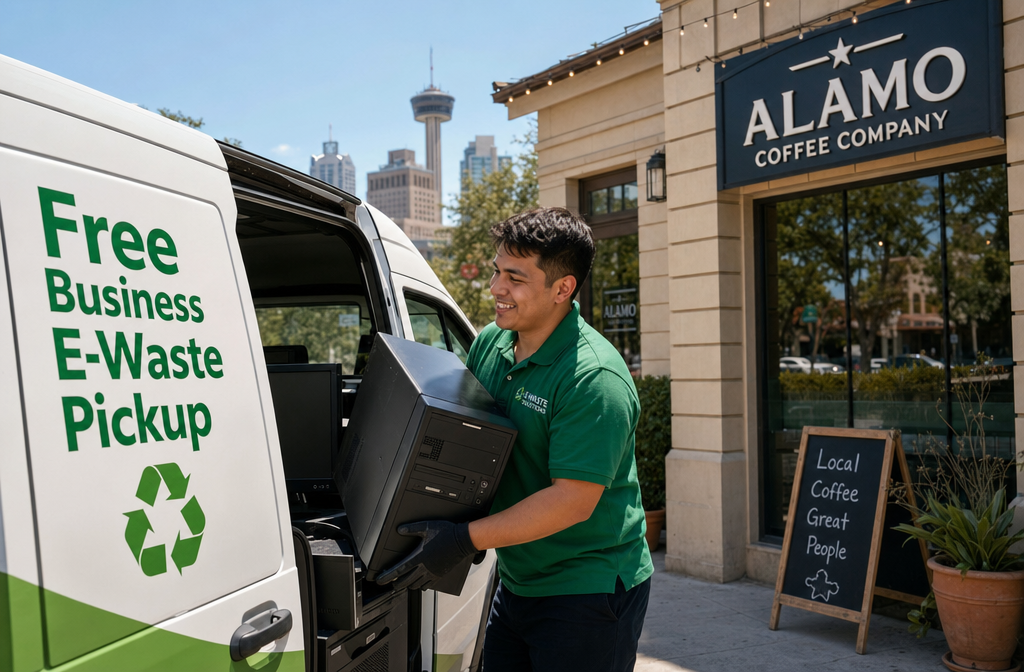
- Confirm the recycler handles Onsite Business Pickup (saves staff time and logistics headaches)
- Request Certificates of Data Destruction for all devices containing business data
- Set a recurring schedule — quarterly or biannual pickups prevent accumulation
- Communicate your sustainability efforts to customers and stakeholders
Going green doesn’t have to cost a thing. Alamo Geeks offers a 100% free business recycling service, available Tuesday through Saturday, making corporate environmental responsibility completely frictionless. No fees, no contracts, no excuses. Devices are securely wiped, and hardware with remaining life gets professionally refurbished — tested with SSD upgrades, fresh Windows or Linux installs, and thorough quality checks before resale.
That’s the full cycle: secure the data, then give the hardware a second, more powerful life.
How Does E-Waste Recycling Support Corporate Sustainability Goals?
Corporate sustainability isn’t just a buzzword for Fortune 500 companies anymore. San Antonio’s local green initiatives increasingly reward businesses that demonstrate environmental responsibility. Eco-conscious clients actively seek out vendors and partners who share their values.
Formal e-waste recycling supports sustainability goals by:
- Reducing landfill contributions — keeping toxic materials out of the waste stream
- Lowering carbon footprint — refurbishing one computer uses a fraction of the energy and resources required to manufacture a new one
- Supporting the circular economy — devices like a refurbished HP ProBook with 16GB RAM and a 240GB SSD get years of additional productive use
- Creating documented ESG metrics — Certificates of Data Destruction and recycling receipts provide auditable proof of responsible practices
For businesses pursuing B Corp certification, green business certifications, or simply trying to win contracts with sustainability-minded organizations, a documented e-waste recycling program is one of the easiest and most impactful steps available.
What About Upgrading Instead of Recycling?
Not every old computer needs to be recycled. Many machines just need targeted upgrades to become productive again. Before sending hardware to recycling, consider whether a component upgrade makes more sense:
- Slow boot times? An NVMe SSD upgrade transforms performance. A budget-friendly desktop with a 512GB NVMe SSD runs circles around an older machine with a spinning hard drive.
- Running out of memory? A RAM upgrade to 16GB handles modern multitasking for most office workloads.
- Need more power for specialized tasks? A Custom Gaming Rig or content creator workstation can be built from quality components at a fraction of enterprise pricing.
Decision rule: If the device is less than 5 years old and the motherboard, CPU, and chassis are sound, upgrade first. If it’s older than 7 years, or the repair cost exceeds 50% of a refurbished replacement, recycle it properly and invest in tested refurbished hardware.
This approach — upgrade what you can, recycle what you can’t — maximizes both financial return and environmental impact.
FAQ
How much does e-waste recycling cost for a small business? It depends on the provider. Some services, including Alamo Geeks’ Free Computer Recycling program, charge nothing for business pickups. Others may charge per-item or per-pound fees.
What types of electronics can be recycled? Desktops, laptops, monitors, printers, servers, networking equipment, cables, keyboards, mice, phones, and tablets. Basically, if it has a circuit board, it can be recycled.
Is data really secure during the recycling process? Only if you use a provider that offers certified data destruction. Always request a Certificate of Data Destruction. Avoid any recycler that can’t provide documented proof of secure data wiping or physical drive destruction.
Can my old business computers be refurbished instead of being scrapped? Yes, depending on age and condition, retired business-class machines — especially Dell OptiPlex, HP EliteDesk, and Lenovo ThinkCentre models — are excellent candidates for refurbishment with SSD and RAM upgrades.
Does e-waste recycling help with tax deductions? Donating functional equipment to qualified organizations can provide tax benefits. Consult a tax professional for specifics, but keep all recycling and donation receipts.
How often should a business recycle e-waste? Quarterly pickups work well for most small businesses. Larger organizations with frequent hardware refreshes may benefit from monthly service.
What happens to recycled electronics? Devices are sorted, data is destroyed, reusable components are harvested, and remaining materials are processed to recover metals and plastics. Working devices may be refurbished for resale.
Are there legal requirements for e-waste disposal in Texas? Texas has specific regulations regarding the disposal of electronics, particularly those containing hazardous materials. Businesses should use certified recyclers to ensure compliance with TCEQ guidelines.
Conclusion
E-waste recycling is one of the rare business decisions that’s good for the environment, data security, and the budget. With 62 million tonnes of e-waste generated each year globally and only 22% properly recycled [5], the opportunity for local businesses to make a meaningful impact — while protecting themselves financially and legally — is enormous.
Your next steps:
- Audit your current inventory of end-of-life electronics this week
- Separate devices with sensitive data from general peripherals
- Schedule a free pickup with a certified recycler that provides a Certificate of Data Destruction
- Communicate your recycling commitment to customers and partners — it’s a genuine differentiator
Alamo Geeks makes this entire process free and frictionless for San Antonio businesses, Tuesday through Saturday. Secure data destruction first, professional refurbishment second, and responsible material recovery for everything else. That’s the full Security-to-Performance cycle — and it doesn’t cost your business a dime.
References
[1] Electronic Recycling 2026 E Waste Stats – https://omegaecycles.com/cybersecurity-tips/electronic-recycling-2026-e-waste-stats/ [2] 50 E Waste Statistics 2025 – https://dtpgroup.co.uk/insight/50-e-waste-statistics-2025/ [4] The Rise Of Formal E Waste Ecosystems In 2026 – https://eridirect.com/blog/2026/03/the-rise-of-formal-e-waste-ecosystems-in-2026/ [5] Electronic Waste Rising Five Times Faster Than Documented E Waste Recycling UN – https://ewastemonitor.info/electronic-waste-rising-five-times-faster-than-documeted-e-waste-recycling-un/ [6] Electronic Waste Recycling Market – https://www.gminsights.com/industry-analysis/electronic-waste-recycling-market [9] United States E Waste Recycling Reuse Service Market Size – https://www.linkedin.com/pulse/united-states-e-waste-recycling-reuse-service-market-size-ja8he
SEO Meta Title: E-Waste Recycling Benefits for Local Businesses in 2026
SEO Meta Description: Discover how e-waste recycling saves local businesses money, protects data, and supports sustainability. Free pickup available in San Antonio.